
When You're Wired Differently, Nobody Hands You the Manual for Love
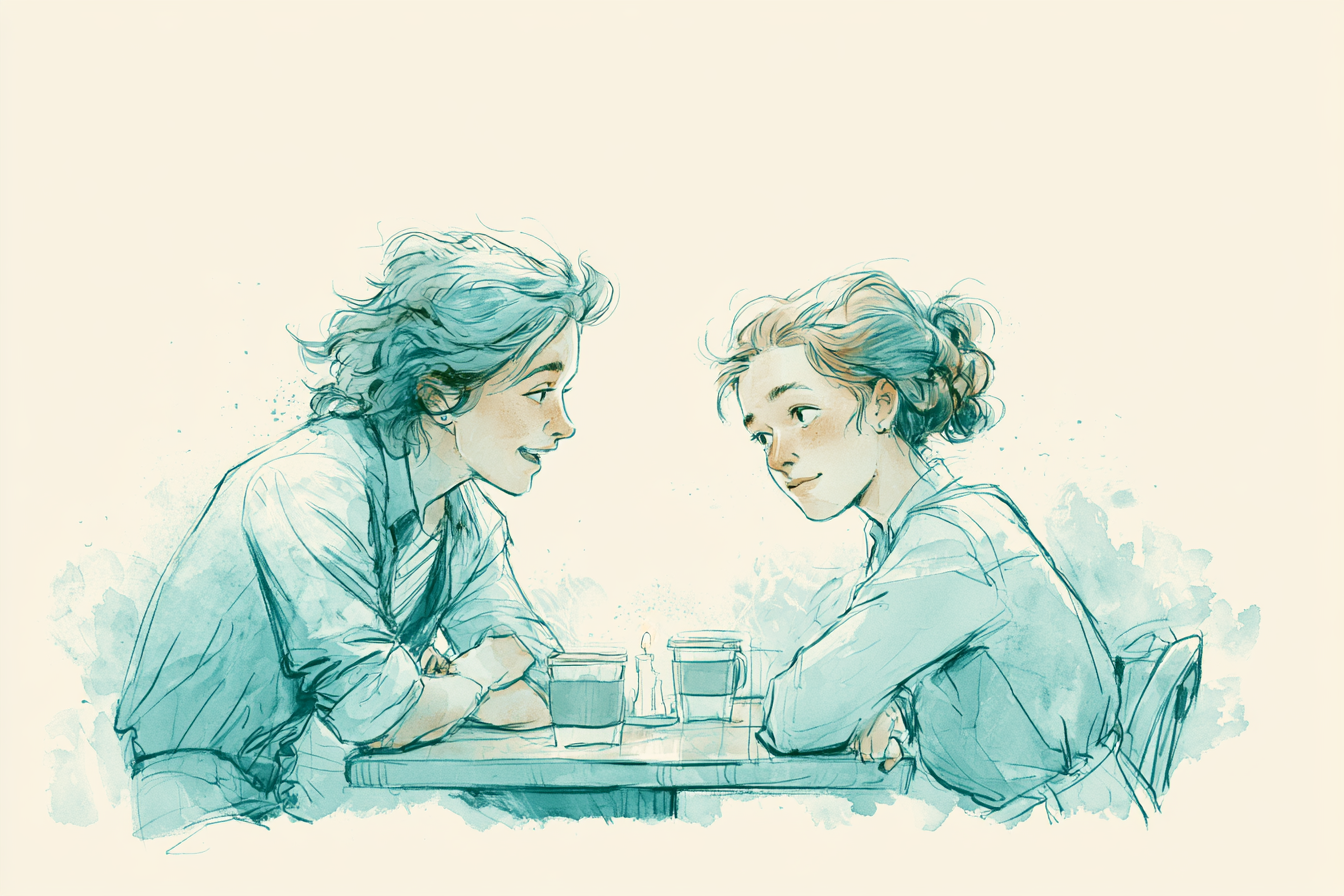
A gentle heads-up before we start: this piece talks honestly about loneliness, relationship loss, shame, and abuse – including a brief mention of my own past suicidal crisis. None of it is graphic, and the whole arc bends toward hope. If any of it feels like too much today, skip to the part you need and come back for the rest. You set the pace.
When I was sixteen, my partner from my Model UN team called the house and asked if I'd like to go to dinner sometime. She said she'd "like to get to know me better." I genuinely could not decode it. So I went and asked my mother whether I'd just been asked out on a date.
She looked at me the way you'd look at someone who'd asked whether water was wet. "What does she have to do, hit you over the head with a club?"
That turned into my first real relationship – one of the most joyful, empowering ones I've ever had.
And decades later, I still don't reliably know when someone is flirting with me.
There's a near-universal neurodivergent experience here, and maybe you know it: realizing someone was interested about three months later, in the shower, replaying the conversation. The signal was sent. It just arrived on a channel I don't monitor.
I want to start there, with the small comedy of it, because the bigger story underneath is not funny at all. A lot of neurodivergent people have spent our whole lives certain we're bad at love. Certain the problem is us.
And I need to tell you, before anything else, what I most needed someone to tell me back when I was undiagnosed and drowning: you are not broken, and you are not bad at this. You were handed the wrong manual for a vehicle (your neurodivergent nervous system and body) that’s wired differently and doesn’t work the same way as what you were taught.
This is the manual section for love.
Let's kill the story that we're bad at this
Around half of autistic adults without intellectual disability are in long-term relationships – and when researchers actually ask, we often rate those relationships as close, supportive, and important, at the same rates everyone else does.
ADHD and AuDHD adults tell a different version of the same truth. The longing runs hot, not cold. Where the research finds strain, it traces that strain to emotion regulation and rejection sensitivity – the too much and never enough problem – not to any shortage of desire or capacity to love.
So whatever is hard here, across every neurotype, it is not a missing ability to connect. We have that in abundance. The difficulty lies somewhere else. And naming where is the purpose of this piece.
But before we get into any of that, the first tool I want to hand you is permission.
You are allowed to want love.
You are allowed to be cautious about it.
And you are allowed to opt out of it entirely.
All three are valid choices, and I mean that.
Two halves do not add up to a whole. Two whole people can choose to travel together – that's a different and far better thing – but you are not a fragment hunting for the matching piece.
The old story that partnership is what finally completes you is wrong, and for us it's dangerous, because it's the exact belief that keeps people in relationships that are hurting them. If you think you need a partner to be whole, you'll accept a bad one rather than be alone.
Many neurodivergent people are asexual, aromantic, or simply happier building life around friendship and chosen family. For some of us, given a hard history, choosing solitude isn't avoidance – it's an informed, protective choice made by someone who knows themselves.
That is allowed, and it is perfectly fine if that’s what feels right to you.
Why it's actually hard – and why it isn't your deficit
For decades the clinical story was that autistic people have a social deficit, and the fix was to teach us to act more neurotypical. The research has taken that apart.
The autistic scholar Damian Milton named the real shape of it: the double empathy problem.
When two people with very different neurotypes try to connect, both of them struggle to read each other. It's mutual. The neurotypical person is just as lost reading us – they've simply never been told they need to learn how. Their style is the default. Ours gets labeled as the error.
When neurodivergent people connect with others wired like them, information flows and rapport rises.
The breakdown was never inside you. It's in the gap. And a gap has two sides.
It's hard, too, because our internal gauges can lie. If you've ever struggled to tell whether you're hungry or tired or overwhelmed, you already know the problem. In dating it shows up as a lonely confusion: not knowing whether you're actually attracted to someone, or whether you've talked yourself into it because they're kind and they chose you.
Hold onto that one. It matters enormously for safety, and I'll come back to it.
And it's hard because of masking. We learn early to camouflage – to perform an acceptable self to get through a world that wasn't built for us – and that performance is exhausting and costly to our mental health.
Now put masking into dating, where the pressure to be likable peaks. You mask to get in the door. The relationship gets built on a self you can't sustain. And the one place you most want to finally drop the mask – home, with the person you love – becomes the place it feels least safe to do it.
That's the cruel center of neurodivergent love: we're often asked to mask the most exactly where we should be the most safe.
"Too much" and "not enough"
Ask neurodivergent people about love and two phrases surface over and over.
The first is too much. Too intense, too invested, too eager, too soon.
Many of us feel at a high amplitude – joy, interest, attachment, all turned up – and we've been punished for the volume since childhood. So we anticipate the punishment and pre-emptively turn ourselves down.
We delay the text. We hide the enthusiasm. We perform a carefully curated version of a person who is, in fact, vibrating with feeling.
And that produces the second phrase: not enough. Cool. Distant. Hard to read.
Here's the shift I’d offer. The intensity that frightens you (and others) is, very often, the same trait that makes you capable of a devotion most people never get to experience. The goal isn't to amputate it. The goal is to find someone who's delighted by it.
And notice where shame sits in all of this.
For a lot of us, "you're too much" isn't fresh feedback from a date – it's a verdict we received so early and so often that we stopped hearing it as an event and started hearing it as a fact about reality. The warning light has been on so long we no longer see it glowing.
A lot of what looks like a dating problem is that old light, reflecting off a new face.
The question no one taught us to ask
This is the heart of it, and it's the part I most want you to take with you.
There are two failure modes, and they look like opposites.
The first is settling – accepting a partner not because they're good for you, not because you're wild about them, but because they'll have you, because being chosen by anyone feels like proof you're not unlovable.
The second is subtler and more dangerous: not being able to tell, from the inside, whether a relationship is even healthy. Not "is this the right person," but something more basic. Is this safe? Is what I'm feeling a fair response to how I'm being treated – or am I overreacting, as I've been told I’m doing my whole life?
Many of us genuinely can't answer that in the moment. And we've learned not to trust our answer even when we have one.
I know this from the inside.
In my early thirties I met someone and fell completely, head over heels in love. I thought I'd found my soulmate.
We merged our lives almost overnight and set off traveling the world. I expected we'd marry on a beach in India.
Instead it turned volatile – brutal fights, intense reunions, then her vanishing for weeks. At one point she left me alone on a suburban street in Kolkata at two in the morning, no taxis, no one around, nowhere to go, while she entered a retreat center I wasn't allowed into.
That moment broke me. And still, for months, I kept chasing her, certain that if I just understood what was happening and loved her enough, I could fix it.
I couldn't fix it, because I didn't have the information. The whole time, she'd been with someone else. When I finally suspected an affair, the truth turned out to be worse: I was the affair. He knew about me. I had no idea he existed until she turned up with a ring on her finger.
When it collapsed, I came apart. I became suicidal. And I stopped trusting my own perception of reality.
That last part is the wound I most want you to understand – because it's the one that makes us vulnerable, and it isn't a character flaw.
Why we're more vulnerable – and it isn't weakness
The research here is blunt.
Autistic adults are several times more likely than non-autistic adults to experience domestic abuse, and more likely to be sexually coerced or threatened by a partner. And here's the finding that should make us angry rather than ashamed: autistic adults report that the sex-and-relationship education they got left them unprepared to even recognize abusive behavior when it was happening.
The vulnerability isn't a defect in us. It's a world and an education that failed to equip us.
The mechanisms stack up. We tend to take people at face value, because we ourselves mean what we say. Many of us learned to fawn – to manage threat by pleasing and self-erasing – which is exactly the response a manipulative partner selects for.
Rejection sensitivity makes leaving feel catastrophic.
And if you can't reliably feel this is wrong in your body, you're relying entirely on thinking to detect danger that is specifically designed to bypass thinking.
Two pieces explain the parts that feel craziest.
The first is intermittent reinforcement, sometimes called trauma bonding. The on-off cycle – vicious fight, intense reunion, withdrawal, reunion – is the single most effective way known to bond a creature to a source of pain. Unpredictable reward is more adhesive than steady reward. It's the same mechanism behind gambling addiction.
Staying isn't weakness, or even love. It's your reward circuitry, hijacked.
The second is the reality-distrust wound: for a mind already inclined to doubt its own read of people, gaslighting doesn't just deceive you – it confirms the worst thing you already believe, that you can't trust what you perceive.
That's why I came apart. The betrayal was bad. The demolition of my sense of what was real was worse.
This vulnerability concentrates at the intersections. Neurodivergent people are far more likely to be LGBTQIA+, and the risks multiply for those who are also trans, Black, Indigenous, or otherwise marginalized. If that's you, the safety steps below aren't optional extras. They're essential.
So what do you actually do? Not in the flooded, mid-attachment moment – almost no one can think clearly there.
You build the literacy beforehand, and you lean on people outside the situation.
Believe them the first time. Maya Angelou's line – when someone shows you who they are, believe them the first time – is the whole red-flag curriculum in eleven words.
The information is almost always there early. We override it because we're compassionate, because we want it to work, because we don't want to be alone. Treat the first instance of cruelty, dishonesty, or contempt as data, not a fluke. It is rarely a fluke.
Go slower than feels natural. The headlong dive – deep and fast because the chemistry is overwhelming – is exactly the condition under which we miss everything. Slowness isn't coldness. It's giving your late-reading gauges time to report in.
Recruit an outside instrument. When your own gauges are unreliable, borrow someone else's. A trusted friend who'll tell you the truth is, functionally, an external dashboard.
The honest catch is that in the thick of it you may not be able to hear them – and you might even resent them for it. In that relationship I mentioned, I did have a close friend who tried to warn me that something was off. I ended the friendship instead of listening. I thought she was just jealous. She wasn’t. She saw something I couldn’t, and I just wasn’t willing to hear her warning.
So set it up in advance, while you're clear. Tell someone you trust: if you ever see something that scares you about how I'm being treated, say it plainly – and I'm telling you now to keep saying it, even when I don't want to hear it. You're leaving your future, flooded self a note from your present, clear self. And then be willing to listen, even if it’s hard.
If it's not just unhealthy but dangerous – if you're being hurt, controlled, frightened, or coerced – that's a safety situation, and leaving is the most dangerous moment in it, not a thing to improvise alone. In the U.S., the National Domestic Violence Hotline is free and staffed around the clock: 1-800-799-7233, or text START to 88788. If you're in immediate danger, that's what 911 is for.
Charlie Brown was never the problem
You know the bit. Lucy holds the football, Charlie Brown runs to kick it, Lucy yanks it away, he lands flat on his back. And the lesson the world hands him is: try harder, trust harder, kick better.
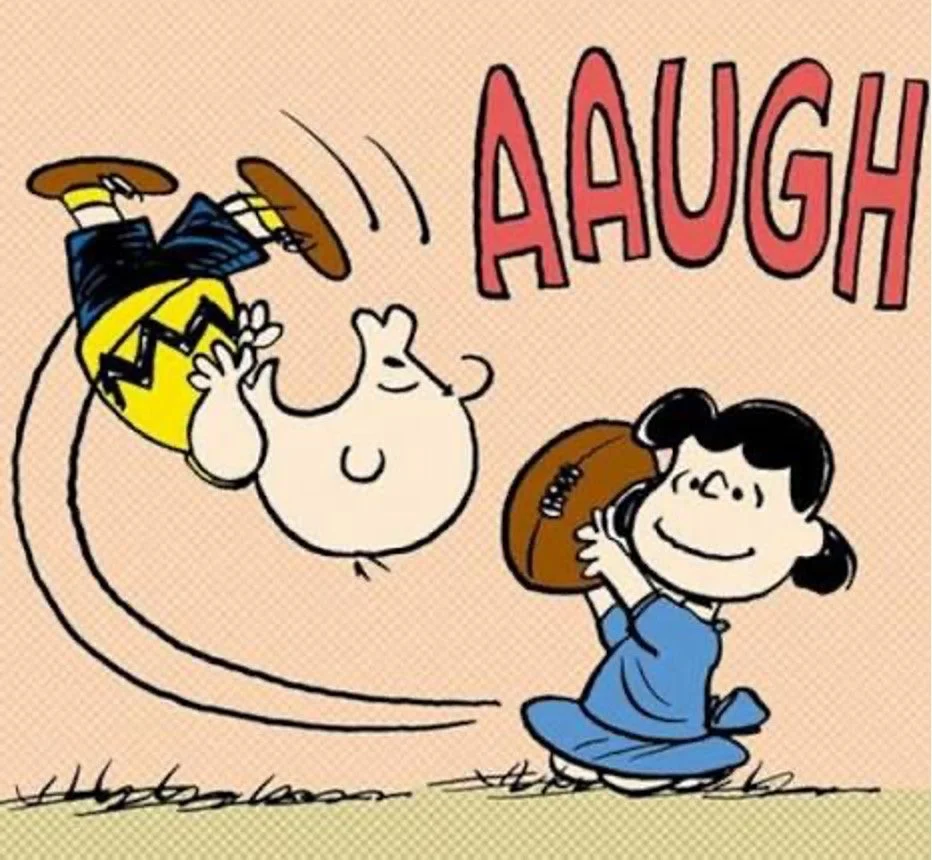
Image credit: Charles M. Schulz
Wrong lesson. The problem was never his form or his trust. The problem is that he keeps trusting someone who has shown him, again and again, exactly who she is.
You are not the problem for having been hurt. And you are allowed to stop running at that particular football.
The no-closure trap
A lot of us get stuck on relationships that ended without explanation. There's a name for what that does to us: ambiguous loss, the family therapist Pauline Boss's term for grief with no resolution and no clear ending to mourn.
A relationship that just fades, with no stated reason, is exactly that – a loss with the closure surgically removed.
And it lands harder on minds like ours, for reasons we can name:
· The near-physical drive to resolve something unfair.
· Monotropism, the way our attention locks deep into a single channel and turns a lost attachment into a punishing loop.
· Rejection sensitivity, which files every vague ending under rejection
· And the default we reach for when no reason is offered – what did I do wrong?
The way out is a reframe plus a practice.
The reframe: closure is something you give yourself, not something they owe you or will ever provide. You're waiting at a window that isn't going to open, and the waiting is the wound now, not the loss.
The practice: separate the two sentences that have probably fused in your mind – "I will never know exactly what happened" and "it was my fault." The first is almost certainly true, and you can make peace with it. The second is almost certainly false, and you can put it down.
You'll probably never get the explanation. You can still let go of the tug-of-war rope.
Finding your actual fit
Enough hazards. They're real and you needed them named, but they aren't the whole story, and a guide that left you only frightened would be its own kind of failure.
Here's the hopeful part. Many of us discover, sometimes late, that the exhausting translation work we assumed was just what relationships cost – it simply stops, with the right person. The thing we took for an incapacity for connection was, in part, an incompatibility of operating systems.
You're not looking for your identical twin from another mother.
Picture a Venn diagram – not two separate circles, not one merged blob, but real overlap with both circles still clearly intact.
The test isn't how much you share. It's this: do they treat your differences as points of fascination, even the ones they don't share – or as flaws they want you to hide? And, just as important, because you get a vote: do you feel the same way about theirs?
There's a question I get more than almost any other: when do you tell someone you're neurodivergent, and how much of the real you do you show, and when?
Here's how I see it.
Some masking on a first date is realistic and not a moral failing – revealing every quirk on date one is a lot like doing it in a job interview. Too much too soon is likely to be the end of the opportunity.
You're allowed to want a second date. But masking has a function: to hide and protect your most vulnerable self.
And the function of dating, over time, is to find out whether someone can accept – and ideally delight in – your actual self.
So think of it as a reveal clock, not a switch.
Strategic, time-limited masking to get in the door, then a deliberate, steady letting-down of your mask. Far better to find out in two months than after ten years that you're stuck in a performance you can't keep up and can't drop without being rejected. The unmasking isn't the threat to the relationship. It's the test the relationship exists to pass.
When I met the woman who's now my wife, I was a year out of a divorce and frankly terrified of starting over at fifty with three kids still at home.
Our first dinner felt as though we'd always known each other. It moved fast – too fast – and I didn't yet know I was autistic, so I was masking heavily, which means the early relationship was built partly on a self I'd later have to renegotiate.
We're a cross-cultural couple and a cross-neurotype couple, still doing the genuinely hard, genuinely worth-it work of loving each other across the gap.
I won't pretend it's easy. It's not.
But when difficulties come up, we choose love, and we keep learning each other's language. Literally and figuratively. I’m learning Spanish and have gotten far enough along that I can mostly understand what my wife and her family and friends are saying, although sometimes my mistakes in trying to respond are pretty hilarious. And we’re building a shared language of communication styles and ways of listening that work for our very different brains. It’s slow, hard work, and there are still (after 7 years together) a lot of times when signals cross. But we’re committed, and we’re working on it.
I share the caveats – too fast, masking, unfinished – not to dim the happy ending but to make it usable.
Real love isn't the absence of all this. It's two people deciding to keep learning each other anyway.
The mechanics nobody taught us
Here's the part most dating advice skips. The actual how.
The throughline is simple, and it cuts against everything the social world tells us to do: don't try to get better at reading minds. Get better at being explicit, asking directly, accepting the answer, and checking your read instead of guessing. The bluntness the world treats as our liability is the single most useful tool we have here.
Stack the deck on where you meet people. Cold-approaching a stranger in a loud bar is close to the worst possible arena for us – maximum performance, minimum information, cues flying past faster than we can catch them.
Meet people around a shared interest instead, where the connection forms over the thing rather than over your ability to perform small talk.
Clubs, classes, fandoms, gaming and online communities, volunteering, neurodivergent meetups, introductions through friends who actually get you. Dating apps that let you lead with writing do the same favor.
Stop staking your love life on cue-reading and lean on two things that don't require it: reciprocity, and asking.
Reciprocity is the signal, and it's far more reliable than a look or a laugh. Does this person reply? Start conversations, not just answer yours? Ask you questions back, remember what you said, suggest the next thing? Interest shows up as someone making it easy.
Friction – vague answers, one-word replies, never proposing an actual time – is itself the signal, even when the words are perfectly warm.
And when in doubt, ask. Out loud. "I'm not great at reading signals, so I'd rather just ask – are you interested in a date, or do you see this as friends?" Naming your uncertainty as a feature defuses it, and most considerate people will think better of you for asking.
Then there's the rule that resolves the fear so many of us carry, and I want to say it as plainly as I can: expressing interest is not creepy. Not accepting the answer is.
State your interest clearly, one time, give them an easy out, and then honor whatever comes back – the first time.
Don't ask again hoping they'll reconsider. Don't relitigate, don't escalate, don't show up uninvited.
And learn what a "no" looks like when it's wearing manners – "I'm really busy lately," a vague non-answer, an excuse with no counter-offer, replies that get shorter and slower. Those are all a no.
Your willingness to accept it the first time is exactly what makes you safe. It is the opposite of creepy. In college, I led workshops for fellow students at Harvard on date rape prevention. Learning to accept a “no” is step one. No means no. But what works better is an affirmative “yes.” Preferably an enthusiastic one.
Which brings me to the trap the most conscientious of us walk straight into. Because we're so afraid of being creepy, of misreading, of being "too much," we conclude that the safest thing is to never approach anyone at all.
Stay home. Take ourselves off the field.
It works, in a narrow way – you never make anyone uncomfortable.
You also never connect, and the loneliness just grows, quietly, in the dark.
And there's a harder twist at the level of the whole dating pool: the people most careful about consent, most able to take a no gracefully – the ones who'd make the safest, kindest partners – are precisely the ones who remove themselves out of fear. Which leaves the field to the people who never worried about any of it.
So hear this plainly. Your conscientiousness is not a reason to disappear. It is the exact quality that makes you worth dating.
Most individual attempts will lead nowhere, by the way. That's not a verdict on you – it's the base rate of the whole enterprise, for everyone.
It's a lot like applying for jobs: many tries, a lot of silence, and eventually a yes.
People who do well at dating aren't getting a higher batting average. They're taking more swings and not letting the misses define them.
For a rejection-sensitive nervous system that math has to be translated, because a single ghosting will try to tell you that you are fundamentally unlovable.
That message is lying. This particular thing didn't work out is true and survivable. I am the problem and I'll always be aloneis the RSD talking, not the evidence.
Other shapes a love life can take
Monogamy is the default the culture hands you, but it isn't the only valid shape – and neurodivergent people are notably more likely to be drawn to others: polyamory, open relationships, asexual and aromantic lives, queerplatonic partnerships, configurations that don't come with tidy names.
The same independence from social convention that costs us elsewhere also means we're more willing to ask whether the standard package actually fits.
And these aren't fringe choices for us. A growing body of research finds neurodivergent people overrepresented in consensual non-monogamy, kink communities, and asexual and aromantic identities.
Part of why is that non-monogamy done well runs on explicit, spelled-out agreements rather than the unwritten rules we keep tripping over – which, for a lot of us, is a relief, not a burden.
I have to be straight with you about where my authority ends, though. I'm not a sex therapist. I'm not LGBTQIA+, and I'm not polyamorous. I can name common themes and flag the challenges my clinical experience and the research point to, and I hold space for all of it without an ounce of judgment.
But I don't have the lived experience or the specialized training to offer real guidance inside those communities, and I won't pretend otherwise.
If you're navigating queer relationships, non-monogamy, kink, gender, or asexual or aromantic partnership and you want support, seek out a clinician with deep training and, ideally, the relevant lived experience. You deserve a guide who knows the territory, not a well-meaning tourist like me.
Back to the room
I'm living proof that the prison has an escape route.
At my lowest point, after that "soulmate" relationship came apart, I came so completely undone I nearly checked myself into a mental hospital. That would have been a disaster, for me, and even in my broken state I was smart enough to realize that.
Instead I left San Francisco, went home to Michigan near my parents, and spent eighteen months reassembling my life and my spirit. And then I chose to risk love again, with eyes more open.
The risk is real. I won't pretend otherwise.
The relationship I wound up in next lasted sixteen years and gave me three amazing children who wouldn't otherwise exist – and it was persistently unhappy, and ended in a divorce I never expected.
I wish I could tell you there was a clean ending. Real life isn't so tidy.
Your story is probably also not linear and simple. You've probably had your own setbacks and confusing chapters. You might, like me, carry enormous self-doubt and a habit of blaming yourself.
But it's possible – just possible, and worth considering – that you are not bad at this. You are not too much. You don't need anyone else to make you whole. And you might, if you choose, bring someone into your life who opens up joy that's hard to find alone.
It's not two halves making a whole. Ideally it's 1 + 1 = infinity.
There was never anything wrong with you. You were just driving a remarkable, complicated vehicle with the wrong manual in your hands.
Drive carefully – and don't be afraid to let the right person ride along, at the right speed, who thinks the strange and wonderful way you're built is exactly the point.
A few questions to sit with
Think of a relationship that ended in a way you never understood. Try writing the two sentences separately: "I will never know exactly what happened," and "It was my fault." Which one have you been treating as true – and what changes if only the first one is?
Where's the line, for you, between a difference you find interesting in a partner and one you genuinely can't live with? Name one of each. (You get a vote.)
Recall a time you felt you were "too much," or shrank yourself to "not enough" to be safe. What was the intense trait underneath – and who in your life delights in it rather than asking you to turn it down?
Who is one person you trust enough to be your outside instrument? What would you want to tell them now, while you're clear, about what to say to you later once things get complicated?
Want to go deeper?
The full guide that accompanies this article – Love and Dating When You're Wired Differently – goes much further: the body in the room (hypermobility, POTS, chronic pain and how they show up on a date), trauma and attachment in detail, the "designated patient" dynamic and how couples therapy can deepen it, the truth about the BPD label and the word "narcissist," scripts you can steal for asking someone out and accepting a no, and a full resources list with specialist voices for the territory outside my lane. It lives in the Members section of my website, along with the other handouts I've written for clients across a wide range of topics.
For a limited time, I'm opening the Members section to readers at no cost. (Eventually there will be a paywall, but you early arrivals – along with my therapy clients – will keep free access.)
👉 https://www.thrivingfamilytherapy.com/member-access – Password: friendoftft!
💙 Want more like this?
If this resonated with you, I'd love to stay in touch. I send occasional emails with resources, reflections, and tools for neurodivergent people and the families and therapists who support them.
👉 Download my free guide: "5 Stress Regulation Strategies for Neurodivergent Adults" – and you'll be on the list.
I'm also working on a book — A Field Guide to the Wrong Planet — for neurodivergent adults who got the label (early or late) without ever getting the manual. The friendship and community material above comes from a chapter in progress, and I'd love your voice in it. If you've got an experience, a story, or a perspective on neurodivergent friendship and belonging that you'd be willing to share, I'm collecting reader contributions here:
Share your story. Anonymous is fine. Every piece helps make this book more honest and more useful.
K. David Smith, LCSW, CASDCS, CCTP, CFTP is a neurodivergent-affirming therapist at Thriving Family Therapy in Grants Pass, Oregon. He specializes in complex trauma, autism, ADHD, and AuDHD. He was diagnosed autistic at 56.
www.thrivingfamilytherapy.com • @ThrivingFamilyTherapy
This article is for informational and educational purposes only. It is not a substitute for the advice of a licensed therapist, physician, or other qualified professional. If you are in crisis, please contact a crisis line or emergency services. In the U.S., call or text 988. © K. David Smith Coaching LLC, dba Thriving Family Therapy. All rights reserved.
