
Why Friendship Has Always Felt So Hard — And What Actually Helps
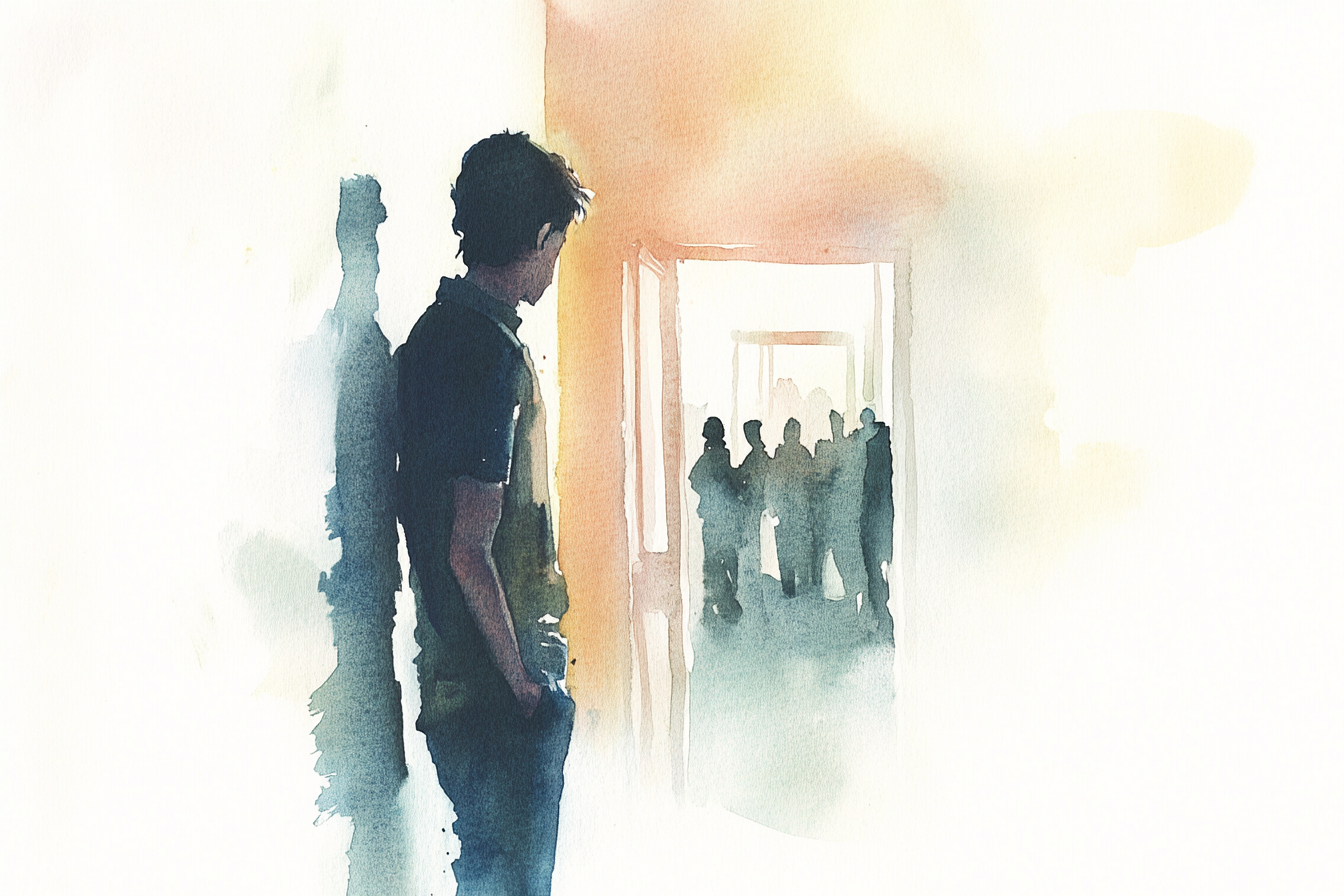
A few months ago, I reconnected with a college roommate I hadn't spoken to in 35 years. We’d been trying to get together for a long, long time, but finally made it happen when I was stranded in San Francisco between flights for a few days. We met near his home in Buena Vista, not far from some of my old stomping grounds when I lived in SFO in the late 90s.
Despite all the years we’d spent on separate paths, it was like we were roomies again. We talked for hours. We've stayed in touch since, although I wouldn’t say it’s very consistent. Consistency in friendships isn’t one of my strong suits.
We're both AuDHD, both recently figured that out, and at some point in the conversation we landed on the same realization: the way we'd both lived our social lives — the long silences, the sudden intense reconnections, friendships that don't run on the schedule everyone else seems to follow — finally made sense.
When my roommate told his husband about the call and the 35-year gap, his husband said, dry as a martini: “Sounds like a really good friend.”
Ouch. Touché.
And also — that friendship is real. It's always been real. It just doesn't run on the neurotypical maintenance schedule, and it never did.
I think about that exchange a lot, because it captures something that almost never gets said out loud: neurodivergent people are not bad at friendship in some general, character-flaw kind of way. We're often very good at specific kinds of connection, and genuinely struggle with others — and we don’t often talk about which is which, or why.
The longing is real
Let's start here, because it matters: neurodivergent people are not less interested in friendship than neurotypical people. We're not indifferent to connection. We don't prefer isolation. That’s a myth that’s baked into the very word “autism,” which has its root in the Greek word “autos,” which means “self.” It originally was intended to describe a condition in which a person is removed from social interaction.
That’s a false construct from the get-go.
A 2024 scoping review of research on autistic friendship found something that should be obvious but apparently still needs saying out loud: it's not disinterest that separates autistic people from others. It's that we want friendship and keep running into social and environmental barriers that get in the way.
Sixty percent of autistic young adults wish they had more friends, compared to 18% of their non-autistic peers. The gap isn't in desire. It's in access — in the specific mechanics of a social world built for a different kind of brain.
If you've spent years feeling like you were failing at friendship — like something was wrong with you, like you just didn't try hard enough — I want to offer a reframe. (That’s what we therapists often do. We reframe. As Wayne Dyer said, when you change the way you look at things, the things you look at change.)
You don’t suck at friendship. You were just navigating a set of systems that were never built for how your brain works.
That's different from failing.
Two kinds of lonely
There's a kind of loneliness that happens even when you technically have friends.
You're at the dinner party. You were invited. People would say, if asked, that they consider you a friend. And yet you go home feeling more alone than before you arrived. And probably exhausted from all the “peopling.”
Researchers call this relational loneliness — having relationships that don't meet your actual need for connection. You're nodding along during the local gossip, or quietly doing the dishes while everyone else chatters about football, waiting for a deeper conversation that never quite shows up.
Then there's collective loneliness — not feeling like you belong anywhere, like the basic fabric of the social world was woven for someone else.
The “wrong planet” idea that's so common in ND communities captures this well: we're aliens who somehow ended up here by accident, and these humans are just... bizarre.
Most ND people experience both. Often at the same time. The familiarity of it can make it hard to imagine anything different.
That's really what this whole piece, and the 70-page handout/book section that underlies it, are for — to start imagining what different might look like.
As I’ve mentioned elsewhere, I’m hard at work on a book I’m calling A Field Guide to the Wrong Planet. It’s intended to be a user’s manual for neurodivergent life. The piece about friendships and community is one of the most important parts, and I’ve just completed a first draft of that segment. It’s up on my website as a client handout. More about that at the end.
The people who disappear (and why that's not what it looks like)
One of the more disorienting things about my own social life — and something I hear from clients constantly — is what I've started calling the now/not-now problem, but in this context, it happens with people instead of time.
You've probably heard of ADHD time blindness: time collapses into “now” and “not now,” and only “now” feels real until “not now” suddenly becomes urgent. Wait, that's due today?
What's talked about less is how this applies to people.
When someone isn't physically present and isn't actively reaching out, they can simply stop occupying mental space. Not because you don't care. Not because the friendship isn't real. But without something in the present — a text, a shared space, a reason to think of them — they fade from active awareness in a way that, apparently, doesn't happen for most neurotypical people.
I can go months without thinking much about people I consider close friends. (Or years, or decades, as in the case of my roommate.) Even my own kids, now mostly grown. I think about them when something reminds me of them, or they reach out, or I see something I want to share. But the background hum of thinking about the people I love — that steady ambient awareness most people seem to carry — runs quieter in me, or is lacking altogether.
It’s weird, I guess, that my own kids fade from my awareness when they’re off at college in Boulder. Their mom calls them daily. (Which is its own kind of problem, probably.) Their dad, namely me, might reach out every two weeks or so. And it’s only because I wake up and realize, wait, I haven’t checked in on the boys for… when did we last talk? Has it really been that long? Wups.
When we reconnect, the warmth is immediate and complete. The relationship is exactly where it was. But I usually feel a flash of guilt about having “ignored” them. From the inside, the gap doesn't feel like absence — it feels like nothing. Not loss. Just a pause. I’m just busy in my own monotropic world. The absent-minded professor off playing in his laboratory. (Pronounced laBORatory, of course. Bwaha.)
From the outside, though, it can look like neglect. Or like the friendship wasn't important.
It was. It is. It just doesn't run on the expected schedule, and never did.
The friendships that survive
The friendships that have lasted for me — and this lines up with what I hear from clients — share one quality: low maintenance without low meaning.
My closest friends are scattered across the country. We go months without contact, sometimes longer. When we reconnect we pick up in the middle, not at the beginning. The relationship is just there, like a favorite book you haven’t picked up in a while. Still there, on the shelf, waiting. Still just as engrossing as it always was.
What makes this work is that both people share an understanding about the maintenance schedule. Neither one is keeping score. Neither one reads absence as rejection.
Finding people who work this way — who can disappear and reappear without it meaning anything — might be one of the most important things an ND person can do socially.
They're not easy to find. But they're worth looking for.
It's not just you — it's a two-way mismatch
For a long time, the dominant explanation for why autistic people struggle socially was deficit-based: something is wrong with the autistic person's ability to read social cues, feel empathy, develop “theory of mind” — the ability to recognize that other people have their own thoughts, feelings, and perspectives separate from your own — and generally understand others.
Autistic researcher Damian Milton proposed something different in 2012, and it's held up well since: what he called the double empathy problem.
The communication breakdown between autistic and non-autistic people runs in both directions. Non-autistic people also struggle to read and connect with autistic communicators. The mismatch doesn't live solely on one side.
A 2024 study in the journal Autism backed this up directly: put two autistic people together, and a lot of the communication friction disappears. Put an autistic person with a non-autistic person, and both struggle — though historically, only one of them has been told the problem is theirs.
This matters enormously for how we think about ND friendship. The difficulty isn't just a deficit to overcome on one side. It's a compatibility issue, and it runs both ways. Which means finding people who share your neurotype — or who are genuinely curious about and compatible with it — isn't a luxury. It's a legitimate social strategy.
When friendship has taught you that you're too much
Most late-identified ND adults don't arrive at friendship as a neutral activity. We arrive with a history.
Years — often decades — of getting it wrong in ways we couldn't see or explain.
Saying the thing that made the room go quiet.
Being the last to understand the joke.
Discovering, slowly or all at once, that people who seemed friendly weren't actually friends.
Being mocked in ways we didn't recognize until much later — the laughter we thought was with us, that turned out to be at us.
Being told, directly or through a thousand small signals, that we were too much, or not enough, or somehow both.
That's not a small thing. It's traumatic, in the clinical sense.
Autistic adults experience diagnosable PTSD at rates of 32 to 60% over our lifetimes — compared to roughly 4.5% in the general population. ADHD adults report significant trauma histories at rates approaching 80% (which doesn’t necessarily mean PTSD, just traumatic experiences that could lead to PTSD). See my article about the overlap between complex trauma and neurodivergence here.
Those numbers don't describe a handful of unlucky cases. They describe the ordinary experience of moving through a social world built for a different kind of nervous system, without any framework for understanding what was happening.
The trauma isn't always one big event. More often it's what Pete Walker, in his work on complex PTSD, calls cumulative relational trauma — the weight of countless smaller experiences of rejection, humiliation, and not-belonging, stacked up over years without resolution.
The nervous system doesn't distinguish between one catastrophic wound and ten thousand small ones that never fully healed. Both leave marks.
And here's where the fawn response comes in — the trauma response that gets a fraction of the attention fight, flight, or freeze get, despite being, in my clinical experience, the default mode for a huge number of ND adults with complex trauma.
When you learn early and often that your authentic responses lead to rejection or ridicule, you learn to monitor the other person constantly and adjust yourself to manage their experience of you. You get good — really good — at reading what someone wants you to be, and becoming that. You learn to deflect, accommodate, smooth things over, make yourself small enough to be tolerated.
That’s what masking (or camouflaging, if you prefer) is all about.
That's not a character flaw. It's a survival strategy that worked. It got a lot of us through school, family dinners, jobs, situations that would otherwise have been unbearable.
The problem is that it outlasts the situations that made it necessary — and it makes real friendship genuinely hard.
You can't connect authentically with someone while you're simultaneously scanning them for disapproval and adjusting yourself in response. The person they're responding to with warmth isn't really you. So the warmth doesn't really register. And the loneliness persists even inside relationships that look, from the outside, like connection.
Fawning also explains some of the reactivity that shows up when ND adults finally start asserting themselves. Years of suppressed authentic response can leave someone with a very low tolerance for dishonesty or hypocrisy once that suppression starts to crack. When something is false, or unfair, it can feel impossible to just let go.
I know this one personally. When I sense someone has said something untrue, I become like my dog playing tug-of-war. I simply will not, cannot, let it go.
This isn't a personality quirk — it's the pressure of years of enforced compliance finding an outlet, often connected to a deep, pre-existing commitment to fairness that the fawn response tried to bury but never fully could.
The ND “justice warrior” — the person who can't let the factual error pass, who has to correct the record even when nobody else in the room seems bothered — is often someone whose authentic voice was suppressed for a long time and is taking some of it back. It can be costly socially. It's also, often, pointing at something real. Both things can be true.
And then there's the harder problem underneath all of this: trusting your own read of things.
After enough times being sure someone was a friend and finding out they weren't — sure the room was laughing with you and discovering they were laughing at you — many ND adults stop trusting our social instincts at all. Not because the instincts were never there. Because we’ve been wrong often enough, visibly enough, that the confidence eroded.
That creates a genuine bind. You need some trust in your own perceptions to know when it's safe to be more yourself. But your history has taught you that your perceptions aren't reliable. So either you stay in fawn mode permanently, or you trust your read at the wrong moment and get hurt again.
Neither option is good. Both make complete sense given what got you here.
Rebuilding trust in your own perceptions is slow, nonlinear work — but it's real work, and it's one of the things therapy, especially body-based approaches and modalities that work with the parts of you that built these defenses, can genuinely help with. Not by making you certain your reads are correct. But by giving you enough internal stability that the uncertainty stops being so destabilizing.
The false tribe
One of the most painful things I know — personally and clinically — is discovering that what you thought was your tribe, wasn't.
After my divorce in 2018, I found out over time that the group of couples my ex-wife and I had socialized with for years — people we'd raised kids with, vacationed with, shared holidays with — were her friends. Not mine.
The invitations stopped almost immediately. I was slow to catch on, because reading implicit social signals has never been my strength.
I kept trying. Inviting people for dinner. Suggesting get-togethers. I tried hard never to say an unkind word about my ex-wife, never asked anyone to choose sides.
They'd respond with warmth and vague promises and full calendars. Sounds good — we'll check our schedules and get back to you.
They never did. It took me years to fully receive the message.
What I've come to understand is that I'd been present in that social world by virtue of my role — husband to a dynamic, gregarious spouse, co-parent, member of the small-town professional class — not by virtue of genuine connection.
In a lot of those relationships I'd felt vaguely out of place the whole time. The conversations I actually wanted — about ideas, meaning, what it means to live well — weren't the conversations those gatherings were built around. I'd drift to the kitchen. Find the one or two people who wanted to talk about something real. I thought that was just what midlife friendship felt like.
It isn't. The same way many ND people, before diagnosis, assume that the constant low-grade wrongness of social life is just how it is.
If you've experienced something like this — and most ND people have, in some form — I want to offer you permission to actually feel it. The grief of false connection. The years spent on it. And maybe, from that grief, the kind of anger and self-compassion that lets you stop chasing the false tribe and start looking for a real one.
When the story doesn't match what you sensed
One of the cruelest features of ND social experience is the lag between what happens and when you understand what it meant.
A friendship cools, a gathering ends strangely, someone seems different — and you don't find out why until long after that information would have been useful. Sometimes years later. Sometimes never.
I worked with a client — I'll call her Maya, a woman in her early 40s, late-diagnosed autistic — who spent her twenties and thirties believing her friendships were in much better shape than they actually were.
“People would be friendly to me,” she told me, “and I'd take that as meaning we were friends. I didn't understand that friendly isn't the same as close.”
When she tried to deepen those relationships, things would quietly not go well, and she wouldn't understand why.
Maya wasn't being naïve. The signals that distinguish warmth from closeness are almost entirely implicit — tone, frequency, quality of attention, small shifts in behavior that most people decode without thinking. For people whose social learning leans on explicit information, those signals are often invisible, or just ambiguous enough to misread.
What Maya eventually learned was to track behavior instead of feeling. Not does this person seem warm toward me, but do they reach out on their own? Do they follow up? Do they remember what I've told them?
Actions, not words.
Sometimes there's no slow fade — just an ending with no story at all. A friend disappears. No conversation, no explanation, just absence where there was presence.
That kind of loss impacts us differently than an ending that comes with a reason, even a painful one. With a reason, there's something to process, a lesson to eventually find. Without one, there's just a question mark where a person used to be — and a brain that's very good at building a case against itself, searching for the thing it must have done wrong, often finding something, with no way to know if that something was actually the reason.
And then there's a third version, maybe the most disorienting: being told a story that doesn't match what you sensed.
ND people often pick up on real shifts — in someone's energy, their tone, the quality of their attention — even when we can't always name what we're noticing or trust it. And then we're told, explicitly or not, that nothing has changed. That we're misreading. That we're being too sensitive.
If that's happening to you: the confusion you're feeling isn't necessarily a sign your sensing is wrong. It's a sign you're working with incomplete or misleading information, which is genuinely hard.
You might be perceiving something real. Or your nervous system might be raising an alarm based on old data. Both are possible — the work isn't to dismiss what you're sensing, but to hold it loosely enough to test it rather than be ruled by it.
Watching behavior, what someone does rather than what they say, helps here too.
And the unfairness of it is real, not an overreaction. There's something genuinely unjust about someone having enough information to make a decision about you while you have none.
You can't repair what you don't understand. You can't apologize for something you don't know you did.
If you're carrying a loss like this, the goal isn't to solve the unsolvable question — it's to find a way to put it down without an answer. Which is a lot easier to say than to do, especially for a brain that's very good at pattern-seeking and very bad at leaving a puzzle unfinished. These kind of mind-bending relational losses that just don’t make any sense, where you know you are missing critical information about what really happened and there’s no way to access the truth, are in my experience (clinical and personal) the hardest ones to grieve. The internal protest and desire, demand, to know the truth can go on for decades.
I don’t have an answer for that. “Just let it go” is obvious, and doesn’t really help.
The good news? Eventually the “now/not-now” feature of our brains when it comes to people can kick in, and you might forget to think about them. Hooray!
RSD: when rejection hits like an emergency
There's a feature of neurodivergent nervous systems that shapes social life more than almost anything else in this piece, and it rarely gets the attention it deserves outside of Reddit and TikTok.
It's called Rejection Sensitive Dysphoria — RSD — and understanding it and naming it might be one of the more useful things you ever do for your relationships.
Dysphoria comes from the Greek for “difficult to bear.” Accurate.
RSD is an intense, sudden, often overwhelming response to perceived or actual rejection, criticism, failure, or even just the anticipation of any of those — not mild hurt, but a wave of shame, rage, or grief (sometimes all three) that arrives instantly and can hit a 72 out of 10 in seconds, regardless of how big the actual trigger was.
RSD is most associated with ADHD, where it's increasingly recognized as a core feature rather than a side note — research and clinical observation suggest the large majority of ADHD adults experience it to some degree, with some estimates running as high as 99%.
I'll be honest — any time I see a “99%” figure, I get suspicious. It sounds like an election result from a country with one candidate on the ballot and a whole bunch of goons counting the results to tell him what he wants to hear. And it's true that number comes from clinical observation rather than peer-reviewed studies, partly because RSD doesn't yet have its own formal diagnostic category.
Let's just say: it's very, very common in ADHD.
It also shows up in autistic people, in people with complex trauma, and — no surprise — in AuDHD adults, where both sources compound each other.
The triggers are often things other people don't even register: a text that takes a little too long to get a response, mild feedback that lands like a verdict on your character, being left out of a gathering or a photo, a slight shift in someone's tone you can't name but can't stop obsessing about.
The neuroscience here is real, not metaphor.
Emotional pain activates some of the same pathways as physical pain. When your nervous system registers rejection, it's filing it in the same category as being hit.
The prefrontal cortex — the part that would normally say wait, let's think about this — struggles to override an alarm that's firing this fast and this hard.
In ADHD, reduced dopamine and norepinephrine make that override even harder.
In autistic nervous systems, ambiguous social information tends to get processed as threat.
Add a lifetime of real rejection on top of that wiring, and you get a nervous system that's hair-triggered for any sign of disconnection — doing exactly its job, just calibrated for a much more dangerous environment than a slow text reply.
What makes RSD so treacherous socially is that it produces behavior that looks like a character problem from the outside. The sudden, inexplicable withdrawal after a small slight. The disproportionate reaction to gentle feedback. The preemptive retreat from a relationship that was going well, as if trying to get ahead of a rejection that hasn't happened yet. The 11pm message you'll deeply regret by morning.
None of that is a character problem. It's RSD — and the person doing it is usually just as confused and hurt by their own reaction as the person on the other end.
So what actually helps?
Naming it, first. This is RSD. My nervous system is flooded, and my read of the situation might not be accurate yet.
Saying that — even just to yourself — engages the prefrontal cortex a little and creates space between the feeling and what you do next.
The 24-hour rule is widely shared in ND communities for good reason: if a response feels urgent and emotionally loaded, wait a day before sending it. What feels like an emergency almost never is one. The relationship will still be there tomorrow, and you'll have a better conversation regulated than flooded.
Don Miguel Ruiz's second agreement — don't take anything personally — is worth sitting with here, difficult as it is in practice. The core idea is that other people's behavior is almost always about them, not you, despite what your nervous system wants to believe.
That's not a call to suppress what you're feeling or pretend it doesn't hurt. It's a reframe that, with practice, creates a little space between the trigger and the story you tell about it.
For RSD specifically: your feelings are real — always.
Your interpretation of what caused those feelings might not be accurate — worth checking before you act on it.
Physiological regulation comes before anything else. The wave needs to pass before your mind can accurately read the situation.
Move your body.
Slow your breathing.
Cold water on your face or neck.
Anything that helps you get back below the threshold where your prefrontal cortex can come back online.
Reality-checking with someone who knows about your RSD can interrupt the spiral. “I'm in an RSD spiral and I'm telling myself the story that [X] — can you help me check that?” It takes vulnerability, and it takes someone who won't just confirm the worst-case version.
If you're close to someone, it might be worth telling them directly: Sometimes I react really intensely to things that feel like rejection. It's not about you — my nervous system gets flooded. Can we agree to take a break when that's obviously happening, instead of trying to sort it out in the moment?
That's not asking to be managed. It's inviting someone into collaboration on dealing with a real challenge with you.
For ADHD adults: stimulant and non-stimulant medications often reduce RSD intensity significantly — one of the more underreported benefits, partly because RSD has only recently gotten wider recognition as a core ADHD feature. If you're on medication and haven't talked about RSD with whoever manages it, that's worth raising.
And longer-term, therapeutic work on the history that calibrated your nervous system in the first place — IFS, EMDR, brainspotting, DBT skills for distress tolerance — all have real evidence behind them for RSD specifically.
The goal isn't to eliminate the sensitivity. It's part of how you're wired, and it's not something to be fixed away. The goal is enough regulation capacity that it stops running your relational life.
RSD isn't a character flaw, and it isn't weakness. It's a nervous system that feels deeply, shaped by real experiences of real rejection, doing the only thing it knows how to do. With the right tools, it doesn't have to be the last word on what your relationships can become.
The weight of shame
Shame isn't the same as guilt.
Guilt says I did something bad.
Shame says I am something bad.
The difference matters, because the two respond to different things — and ND adults, almost universally in my experience, are carrying massive shame, not just guilt.
The shame here is layered. There's the shame of every time you got it wrong — the awkward thing you said, the friendship you misread, the room you couldn't read.
There's the shame of years spent believing you were fundamentally broken or unlikeable, before you had any framework for why social life felt so hard.
There's the shame of masking itself — years of sustaining a performance, and the unsettling question of what that performance means about who you actually are underneath it.
And then there's the shame that gets activated by comments like “aren't we all a little neurodivergent?” or “I'm a little ADHD too.”
The person saying it usually means well — they're trying to connect, to say “I get it.”
But what it actually communicates, to someone who's spent a lifetime being told their experience isn't as hard as it feels, is: you're making too big a deal of this. You're not as different as you think.
These are microaggressions. They add up. And for people who already doubt their own experience, they're particularly good at reactivating old shame.
I want to be honest about what I know and don't know here.
Bréné Brown's work on shame is real and important — shame does live in silence, and connection genuinely is part of what heals it. But her framework can also suggest that vulnerability is always the answer, that we heal by being seen — and for ND adults with complex trauma, the question of when it's actually safe to be vulnerable isn't rhetorical.
Vulnerability without discernment, in an unsafe relationship, doesn't heal shame. It recreates it.
Here's what I've found actually helps — for clients, and for me.
Just knowing you're neurodivergent — wired differently, not broken, not less — can interrupt the story shame depends on.
Shame's story is that something is fundamentally wrong with me. The neurodivergent reframe is: I was navigating a world built for a different kind of brain, without the information I needed.
That's a different story. It doesn't undo decades overnight, but it gives shame something to argue with.
Internal Family Systems (IFS) has been one of the most useful approaches I've found, personally and clinically, for shame specifically.
IFS understands shame not as a truth about who you are, but as a “part” — often a young part that picked up “something is wrong with you” because that was the only explanation available at the time. That part isn't the enemy. It was doing its job with very little information.
IFS lets you get curious about it — what it's been carrying, what it actually needs — instead of fighting it or being fused with it.
(If IFS sounds unfamiliar, you've probably seen it without realizing it. Dick Schwartz, who created the model, consulted on the Pixar movies Inside Out and Inside Out 2, and they portray it pretty faithfully.)
Self-compassion research, especially Kristin Neff's work, offers something related and well-studied: treating yourself with the kindness you'd offer a struggling friend, recognizing that suffering is part of being human rather than evidence you're uniquely defective, and holding painful feelings in awareness instead of drowning in them or shoving them down.
The research is consistent — self-compassion reduces anxiety, depression, and shame, without reducing accountability. People with more self-compassion are actually more willing to own their mistakes, because doing so doesn't threaten their sense of worth.
Which connects to something I'd call true accountability — different from shame-based self-blame.
Shame says I am bad.
Accountability says I did something that caused harm, and I want to understand it and do better.
Shame freezes you. Accountability moves you forward.
A lot of ND adults with complex trauma have spent their lives in shame when what they actually needed was the ability to look clearly at what happened, take real responsibility for their part, and move on without it becoming a verdict on their worth as a person.
The body matters here too — shame lives in the body as much as the mind. The collapsed posture, the averted gaze, the urge to disappear: these are somatic responses that insight alone doesn't reach.
Somatic Experiencing, sensorimotor work, trauma-sensitive yoga, even careful, consensual, well-boundaried touch — massage, myofascial release, a hug from someone safe — can release some of what cognitive work can't.
And finally: community.
Not just any community — one where you're actually received as you are.
The first time someone meets your disclosure with “yes, me too” instead of “I'm sure it wasn't that bad,” something shifts.
Shame depends on the belief that your experience is aberrant, that you're uniquely broken, that no one who knew the whole truth would stay.
Community that knows the whole truth and stays anyway is one of the most powerful things there is for shame.
The masking tax — and the question of disclosure
A 2025 systematic review found that camouflaging autistic traits to fit socially is common among autistic people trying to build friendships — and that while it can help get through the door, it consistently leads to worse mental health, more burnout, and friendships that feel less satisfying, because they're built on a persona instead of a person.
The paradox: the masking that gets you into the room is the same masking that keeps you from the connection you went there for. Plate armor is very effective at protecting you from hurt. And it’s very hard to give someone wearing plate mail a hug.
For a lot of late-identified ND adults, this is one of the most disorienting realizations of post-diagnosis life. You've spent years building sophisticated strategies for appearing socially fluent — strategies that cost you fatigue, anxiety, a persistent sense of fraudulence — and those strategies produced relationships built on a version of you that takes real work to maintain.
There's no clean answer for what to do with that. What seems to help, in research and in practice, is gradual, selective unmasking — with people who've already shown signs they can hold the real version of you — rather than either staying fully masked or disclosing everything at once.
One client described it as “testing the water at the edge of the pool.” Toe in. If it's not cold — if they meet you with curiosity instead of distance — step in a little further.
Which brings up disclosure directly, and the honest truth is: there's no universal answer here either.
Disclosure carries real risk, not because there's anything shameful about being neurodivergent, but because stigma still exists, and people's reactions are genuinely unpredictable. Some people get more curious, more present, more there for who you actually are. Others quietly pull back. Some can't hold the information without reducing you to your diagnosis — suddenly treating your directness or your sensory needs as “your autism” in a way that feels more like a label and a dismissal than understanding.
The real question isn't whether to disclose — it's when, to whom, and how much. And the answer is different for every relationship.
Behavior before disclosure tells you a lot: does this person ask follow-up questions? Remember things you've told them? Reach out on their own, or only respond to you?
Someone who consistently does these things is more likely to receive your disclosure with care than someone who's shown the relationship only moves one direction.
Partial disclosure is real disclosure. “I'm autistic and ADHD” is one version. “My nervous system gets overloaded in busy spaces” is another. “I sometimes need to leave early — it's not about not wanting to be there” is another.
None of these are less true. The level of detail just reflects what this relationship, right now, can hold.
You can test the water — share something small but real, and watch the response. Not did they say the right thing, but did they get curious, or change the subject?
And after disclosure, pay attention to what changes and what doesn't. The person who treats you exactly the same — who doesn't suddenly decide you're fragile or fascinating — is showing you something. So is the rare person who says: thanks for telling me. Is there anything that would help me be a better friend to you?
That response exists. It's rarer than it should be. It's gold, when you can find it.
Where this leaves us
I don't have a tidy ending for this one, and I don't think one exists.
What I have is this: the difficulty you've experienced with friendship — the misreads, the false tribes, the people who disappeared without explanation, the shame, the RSD spirals, the exhausting calculus of disclosure — none of that is a verdict on who you are. It's the predictable result of a nervous system built differently, moving through a world that wasn't built with it in mind, without a map.
The map is being drawn now. Slowly. By people like Maya, and my college roommate, and my clients, and — honestly — by me, still figuring a lot of this out in real time.
If any of this landed for you, you're not alone in it. That doesn't fix the loneliness by itself. But it's not nothing, either.
💙 Want more like this?
If this resonated with you, I'd love to stay in touch. I send occasional emails with resources, reflections, and tools for neurodivergent people and the families and therapists who support them.
👉 Download my free guide: “5 Stress Regulation Strategies for Neurodivergent Adults” — and you'll be on the list.
I'm also working on a book — A Field Guide to the Wrong Planet — for neurodivergent adults who got the label (early or late) without ever getting the manual. The friendship and community material above comes from a chapter in progress, and I'd love your voice in it. If you've got an experience, a story, or a perspective on neurodivergent friendship and belonging that you'd be willing to share, I'm collecting reader contributions here:
Share your story. Anonymous is fine. Every piece helps make this book more honest and more useful.
