
When Your Nervous System’s Engine Is Running Hot for Too Long
What Autistic Burnout Actually Is – and What Actually Helps

I was eleven the first time I burned out, though I wouldn’t have a name for it for another forty-five years.
My grandfather died. Not only was he the sole source of truly unconditional love in my life, he was the same for my mother. We both went down, hard. I’m still not sure, to this day, that either of us has ever truly recovered.
And I was trying to get through sixth grade as a twice-exceptional kid whose teacher genuinely didn’t know what to do with me. She wanted to punt me up to middle school, as a gifted 11-year-old. My principal and parents intervened, thank God. I’ve written about this elsewhere.
Then, in January of 1980, midway through 6th grade, I caught pneumonia so bad that two of the three nodes of each lung were full of fluid.
The whole thing stacked up until my body simply quit.
I missed a month of school. I watched the 1980 Winter Olympics from the sofa bed in the living room, with my mother – a nurse who had taken time off work to look after me – beside me. I saw the U.S. hockey team shock the world. It’s hard to remember, for many people, that at one time the U.S. was actually an underdog in some things, not the bully of the whole world that we’ve become. Watching a bunch of college kids beat the hockey superpower of the world that had never been defeated in international competition in any meaningful way was… well, it was a turning point. And I was able to watch it from the sofa bed that my mother had turned into my home hospital bed, while I was struggling to breathe. Together with her.
That was truly a life-threatening illness. It was also my first real episode of burnout.
I didn’t know it. Nobody did. What everybody saw was a sick kid, and they weren’t entirely wrong – I was very, very sick. But the stress and the illness weren’t two separate things. They never are. It’s all one system.
That pattern – overload, collapse, effortful recovery, repeat – ran for the next four and a half decades. And the reason I’m writing this is that I’ve finally figured out what was actually happening.
Not as an abstract clinical matter, but as someone who lived it, missed it in himself, and spent years helping other people understand it in themselves.
So let’s talk about it.
It’s Not a Character Flaw. It’s a Mismatch.
Here’s the thing most mental health content gets wrong about neurodivergent burnout: it treats it as something located inside the person. A deficiency, a disorder, a failure of resilience. The fix, then, is to repair the person: medicate them, correct them, get them to try harder.
But you cannot medicate away a situation you have no control over.
Burnout is what happens at the meeting point between a particular nervous system and a particular environment – when the demands of that environment exceed what the nervous system can sustainably carry, for a very long time, with no real chance to recover. That’s Dora Raymaker’s definition, from the foundational 2020 research: “a syndrome resulting from chronic life stress and a mismatch of expectations and abilities without adequate supports.”
The problem isn’t you. The problem is that you’ve been driving a complex, extraordinarily delicate machine with the wrong manual – and the road keeps getting steeper. And the world is not getting easier.
Life in most of the modern West gets faster, more expensive, and more demanding every year. For a neurodivergent nervous system that already runs at a higher baseline cost just for ordinary days, that rising tide hits first and hardest. When your system finally buckles, it’s not telling you that you’re insufficient. It’s giving you accurate information about an unsustainable situation.
What It Actually Looks Like
Strip neurodivergent burnout to its basics and it has three signatures, whatever your neurotype:
Exhaustion that rest doesn’t fix. Not “tired.” Depleted at the cellular level. A weekend, a vacation, a full night’s sleep – none of it touches the core issue.
Loss of skills you used to have. Cooking. Driving. Answering an email. Speaking in full sentences. Washing your hair. Brushing your teeth. Things that were automatic go offline. This is a symptom, not a personality change.
Reduced tolerance to everything. Light. Sound. Texture. People. Decisions. The volume knob on the world is cranked up, and the dial has snapped off.
If rest is fixing it for you, for now, it probably isn’t full burnout.
If three months of reduced load barely moves the needle – that’s the territory we’re talking about.
Here’s what a lot of people don’t know: burnout is not the same as depression, even though it looks almost identical from the outside.
The standard treatment for depression is behavioral activation – get out more, add structure, push through.
For a nervous system in burnout, that’s exactly wrong. It needs less, not more.
Prescribing activation to a burnt-out system is like flooring the accelerator on an overheating engine to “warm it up.” Instead, you flood the carburetor. Or, worse, seize the engine block.
The wrong label gets you the wrong help. And the wrong help makes it worse.
There’s More Than One Kind
“Neurodivergent burnout” is an umbrella term. There are different varieties.
Autistic burnout is driven by cumulative load and masking – the daily, invisible cost of suppressing your natural responses to pass as neurotypical. The research is consistent: masking is the single most commonly named cause. It doesn’t take one catastrophe. It takes years of trying to survive days that cost more than they should, just to camouflage, each one costing more than it should have.
ADHD burnout looks different. It’s more often the crash after a sprint – executive-function overload, dopamine depletion, the hyperfocus-into-collapse cycle. The ADHD brain runs on urgency and interest, which can look like productivity right up until the system gives out. (I want to be honest here: ADHD burnout as a formal construct is still being defined in the research. It’s real. It’s just under-studied.)
AuDHD burnout – the compound crash – is its own particular hell. The autistic side wants quiet, predictability, low stimulation. The ADHD side wants novelty, movement, input. They pull against each other. The recoveries point in opposite directions. Which is why AuDHD burnout tends to be deeper, slower, and more confusing than either alone.
If you’re AuDHD, the question “is this the autistic kind or the ADHD kind?” often has the same answer: yes. The distinctions matter, because your system is giving you conflicting signals about what you really need and what’s really happening. But both are likely in play. Finding a balance that works is challenging.
What’s Happening in Your Body
Understanding the mechanism is how you stop blaming yourself for the behavior. So here’s the honest, non-scary version.
Your stress response is a brilliant system for dealing with short-term threats. Escaping a bear or a flood, or a threatening human.
The amygdala fires, cortisol and adrenaline flood the system, everything non-essential shuts down so you can deal with the threat. In an environment where threats were physical and brief, this worked perfectly. You’d either survive or not, and then the system would reset.
Modern stressors don’t work that way. You can’t fight your boss or outrun a deadline. The cycle starts but never completes. The body never gets the all-clear.
For most neurodivergent people – especially those carrying unresolved complex trauma, which intersects with neurodivergence at far higher rates than the general population – the result is a stress system that’s been operating at redline RPM for years. Sometimes decades.
Sean Inderbitzen, an autistic therapist and researcher whose work applies polyvagal theory specifically to autism, argues that autistic people tend to have difficulty accessing the ventral vagal state – the nervous system’s social-engagement, safety mode. Under chronic load, the system defaults instead to sympathetic mobilization (fight/flight) or dorsal vagal shutdown (freeze, collapse). Burnout largely lives in that last state.
Daniel Siegel gives us a useful frame: the window of tolerance. The zone where you can flex, adapt, cope. Neurodivergent windows are often narrower to begin with. Burnout is what your whole being looks like after your life has sat outside that window for years. Not a bad day outside it. A decade. Or a lifetime.
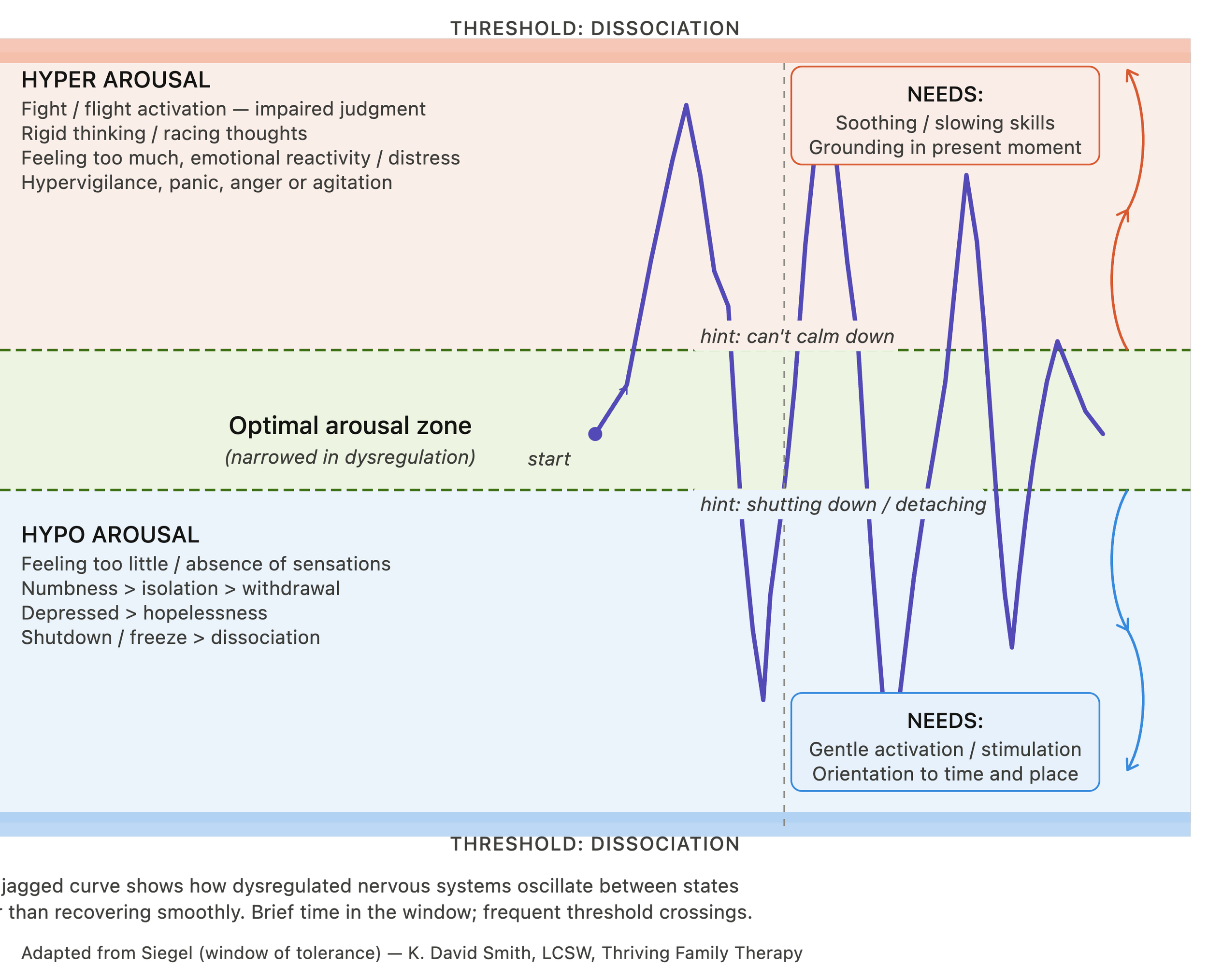
There’s a cellular-level story too. Researchers call it allostatic load – the cumulative wear on your body’s regulatory systems from sustained stress.
Bruce McEwen’s work showed that when the stress response runs chronically, the hormones meant to protect you start damaging the systems they touch: neuroendocrine, immune, metabolic, cardiovascular. This is the rigorous explanation for why burnout can feel like it’s aging you. Because at the biological level, it is.
It Shows Up Differently at Every Stage of Life
One thing that doesn’t get said often enough: burnout isn’t a single event. For most neurodivergent people it’s a recurring shape that shows up differently at each life stage – and the episodes are cumulative. Each one leaves the system a little less resilient than before.
In early childhood it looks like regression, not exhaustion. The toilet-trained toddler starts having accidents. The verbal four-year-old loses words. The child who was sleeping through the night stops. Meltdowns intensify at triggers that used to be manageable.
This is the nervous system reporting that it’s past capacity – and adults, including most schools, almost always read it as behavior to be managed rather than distress to be relieved.
By adolescence, the masking stakes have risen. The neurodivergent teenager now knows they’re different, and the energy spent camouflaging and acting “normal” – holding it together all day, falling apart at home – is enormous. Chronic absence, somatic illness, and withdrawal get labeled as attitude or defiance.
I missed twenty to twenty-five days a semester in middle school. Not because I was lazy. Because being bullied, lonely, and a twice-exceptional undiagnosed neurodivergent “nerd” who didn’t fit in anywhere had pushed me past what I could carry.
College removes the external scaffolding at exactly the moment demands spike. For a lot of late-identified people, this is where the first adult-scale collapse hits.
During my sophomore year at Harvard, I fell apart so completely I couldn’t eat without a stomachache so brutal I’d have welcomed a knife in my gut instead. I couldn’t get to class. I couldn’t function and was increasingly isolating. I ultimately took a year off, went home to Michigan, drove out to California to spend a few months there exploring on my own, came back, and eventually graduated with honors.
Then I turned my back on Harvard and got out of there as quickly as I could. I have barely set foot in Cambridge since. Too many bad memories.
Young adulthood, professional life, parenting, midlife – each stage has its own particular shape and its own particular trap.
(I cover these, and the rest of these topics, in more detail in the full handout on Autistic and Neurodivergent Burnout, available on my website. The link is at the end of this article.)
The through-line is the same: a nervous system running at a higher baseline cost than the environment accounts for, slowly accumulating a bill the body eventually collects.
What Actually Helps
The research is consistent on this. Three things are most associated with recovery from autistic burnout:
acceptance and social support;
time off and reduced expectations; and
doing things in an authentic, unmasked way.
Everything else is in service of those three.
Here are some simplified suggestions. Again, there is a great deal more detail included in my full handout – details about how to access it are at the end.
If you’re approaching burnout: catch it early. Build a “dashboard” for measuring your stress levels that you can actually read – because interoception problems mean your internal gauges often lie (the link will take you to my Substack article on the topic). Track external signals: sleep quality, cancelled plans, whether small tasks feel heavy. Cut one thing now, while it’s still optional. Complete the stress cycle physically – movement, shaking it out, a brisk walk – because a stressor ending isn’t the same as your body knowing it ended.
If you’re in it: the goal is not productivity. The goal is subtraction. Drop, delegate, defer, and decline everything that isn’t either essential or actually nurturing. Stop masking wherever it’s safe. Lower the sensory volume. Use bottom-up regulation – through the body, not the thinking brain, which is offline. Let people help in defined, bounded ways.
If you’re recovering: this isn’t a return to how you were functioning before. That level of output was only possible because you were running past your limits. The work of recovery is building a new normal that you can actually sustain. Rebuild slowly. Protect the foundations – sleep, food, movement that feels good, real connection. And find your people (follow the link to my article on neurodivergent friendships and community). Connection with others who get it is the medicine, not just a nice-to-have.
I want to say something honest about the privilege piece.
Subtractive recovery – take time off, file for FMLA, reduce your hours – is real and it’s good advice. It’s also unavailable to enormous numbers of people who can’t opt out of carrying their load.
I’ve been there.
When I was burning out in my first full-time therapy job while going through a divorce, managing 65 high-acuity clients with a supervisor who told me that “some people just aren’t meant for community mental health” (and meant it as a slur), my PMHNP finally told me: if I didn’t file for FMLA, she would do it for me, because the job was going to kill me.
I took three months of unpaid leave. I ultimately quit. I was still looking for a survivable job that would allow me to keep getting the hours toward licensure without killing me when COVID shut everything down. I wound up unemployed for a year.
The only reason I survived that lost income was because I was fortunate enough to have alimony from the divorce. (My ex-wife made more in two days than I made a month, in case you’re wondering how the wife, not the husband, was paying alimony.) Many people don’t have anything close to that safety net.
If you can’t fully subtract by taking time off completely, you subtract where you can.
You get ruthless about the lowest-value demand.
You stop spending energy masking where it’s safe to drop it.
And you name the trade-off you’re making – “I’m running a deficit on purpose because I have no choice right now” – because naming it lets you watch the gauge instead of pretending it isn’t dropping.
The Point of All of This
I didn’t write this guide to catalog damage. I wrote it because the people who come to me for therapy – the ones who’ve been told their whole lives that they’re too much, or not enough, or broken in some specific and addressable way – are almost never broken. They’re running the wrong software on the wrong hardware with the wrong manual and no maintenance schedule, in an environment that keeps making more demands.
ACEs are not destiny. Allostatic load is not fate. The nervous system that has been redlining since childhood can learn to stand down. Not because you finally become neurotypical – you don’t, and you shouldn’t – but because the conditions around you change, the load decreases, and you finally have a map that tells you where the charging stations are.
That’s what the research actually supports. And it’s what you deserve.
If this resonated – read the full handout (see below), share it with someone who’s redlining, or just sit with the idea that what you’ve been calling a character flaw might be the most rational response in the world to an unsustainable situation.
Because it is.
💙 Want more like this?
If this resonated with you, I’d love to stay in touch. I send occasional emails with resources, reflections, and tools for neurodivergent people and the families and therapists who support them.
👉 Download my free guide: “5 Stress Regulation Strategies for Neurodivergent Adults” – and you’ll be on the list.
I'm also working on a book — A Field Guide to the Wrong Planet — for neurodivergent adults who got the label (early or late) without ever getting the manual. The friendship and community material above comes from a chapter in progress, and I'd love your voice in it. If you've got an experience, a story, or a perspective on neurodivergent friendship and belonging that you'd be willing to share, I'm collecting reader contributions here:
Share your story. Anonymous is fine. Every piece helps make this book more honest and more useful.
