
If You Believe “Everyone Is Neurodivergent,” You’re Part of the Problem
On the erasure of intersectional identity, and what it means to be a true ally
Ever since I was diagnosed with autism last year, at age 56, I’ve been hearing the phrase “everyone is a little bit neurodivergent” a lot. And, as an autistic therapist who specializes in supporting neurodivergent people and their loved ones, I know they hear it too. This trope is showing up with increasing frequency in popular culture — and, more recently, it’s started appearing with a spiritual flavor I find especially troubling.
Just this week, someone I care about commented on my recent Substack post “ Neurodivergent People Often Struggle With Food.” She told me she was no longer going to use my name — she was going to call me “Neurodivergent Person,” because that seemed to be the only thing I identify as or talk about. She told me we are all neurodivergent in some way. That we all have the same needs. And that by writing about neurodivergent experience, I was creating what she called “specialism” — feeding separation and division, the root of suffering, oppression, and violence.
She believed she was “showing me something.”
Now, this is a highly spiritual person, with good intentions and a good heart. She makes a positive difference in the world. She truly believes in a world where everyone is seen for the eternal light within them, not for the mask on the outside, and she practices that as much as she knows how.
And, also, what she said didn’t just challenge the whole basis of my writing about neurodivergence. Including the book I’m working on, A Field Guide to the Wrong Planet, which is essentially a user’s manual for neurodivergent life. She challenged the premise of my therapy practice, my advocacy on behalf of neurodivergent people and other marginalized groups… and a core aspect of my identity (although certainly not the only one, as a complex person with a multi-faceted intersectional identity).
This discussion stopped me cold. I haven’t been able to write this week, and I’ve spent a lot of time meditating, journaling, and calming my nerves, because that discussion hit me like a piano falling on my head from the 5 thfloor. I’ve been thinking about how to respond to that discussion — not just to her, but to the entire pattern of thinking she represents. Because I’ve heard versions of it many times.
And it does very real harm.
The Spiritual Angle
This person’s framing had a particular flavor that I’ve increasingly encountered in what might be called New Age or “spiritual” circles: the idea that because we are all one — all spiritual beings of equal and eternal value — naming difference, suffering, or oppression is itself the problem. That talking about the pain of marginalized people promotes the very “separation” that keeps us all from enlightenment.
There’s a term for this. Psychotherapist John Welwood coined it in 1984: spiritual bypassing. Welwood defined it as using spiritual ideas and practices to sidestep or avoid facing unresolved emotional issues, psychological wounds, and unfinished developmental tasks. He noticed the tendency within his own Buddhist community: people using the language of oneness and transcendence to rise above the “raw and messy side of our humanness” before they’d actually faced it.
Spiritual bypassing has a collective form, too. When someone uses the language of universal oneness to dismiss the lived suffering of marginalized people — to tell a Black person “all lives matter,” to tell a trans person “we are all one,” to tell a neurodivergent person “we’re all a little neurodivergent” — they are not offering enlightenment. They are using the language of transcendence to avoid the discomfort of sitting with injustice and pain.
It is probably not a coincidence that New Age spiritual communities have historically skewed white and upper-middle-class and, in Latin America, tend to be concentrated among those with lighter skin and more economic privilege. When you are not the target of systemic oppression, it is much easier to believe that naming oppression is the real problem.
No, We Are Not All Neurodivergent
Let me be clear about something first, because I always try to assume good intentions.
I understand that people’s motivations for saying “we’re all neurodivergent” differ. Some say it as an attempt at solidarity — an awkward ally reaching across a gap they don’t quite know how to bridge. Some say it from genuine curiosity about their own wiring. Some say it dismissively, as a deflection. And some, like the reader I mentioned, say it as a kind of spiritual correction, an invitation to rise above identification with difference.
I’ll try to take each of those in turn. But first — the factual baseline.
Neurodivergent conditions like autism and ADHD are not just collections of personality quirks that exist in everyone to varying degrees. They are specific patterns with measurable, documented neurological differences from the neurotypical (or allistic) profile. The science on this is substantial.
The Biology Is Real
Functional MRI (fMRI) studies consistently show that autistic brains differ from neurotypical brains in measurable, reproducible ways. A 2024 review synthesizing recent neuroimaging research found that people with autism show reduced gray matter volume in key regions including the amygdala and superior temporal sulcus — areas central to emotional processing and social cognition — as well as atypical white matter connectivity and disrupted functioning in the default mode network, the brain network involved in processing information about oneself in relation to others (Patil et al. 1).
Resting-state fMRI studies of autistic brains have also shown disruptions in how different brain regions talk to each other — both patterns of underconnectivity and, in some regions, hyperconnectivity. This isn’t a metaphor. These are physical differences in neural architecture.
The picture is similar for ADHD. Large-scale neuroimaging studies confirm that ADHD brains show reduced volume in the prefrontal cortex (the region most responsible for executive function, attention regulation, and impulse control), the basal ganglia, and the cerebellum. A landmark longitudinal study at the National Institute of Mental Health found that the cortex in ADHD brains matures on a delayed timeline — roughly two to three years behind neurotypical peers, with the lag most pronounced in the lateral prefrontal cortex (Shaw et al. 19649). Dopamine signaling is disrupted in ADHD, but in a specific way: it’s not simply that there’s “too little” dopamine. The reward circuitry itself is miscalibrated, affecting motivation for routine tasks in ways that are genuinely different from what neurotypical people experience.
“But can’t everyone struggle with focus sometimes?” Sure. And most people have felt sad. That doesn’t mean everyone has clinical depression.
Neurodivergent conditions also have strong genetic signatures. Twin studies consistently find that autism is among the most heritable of all human traits — a meta-analysis of thirteen twin studies found heritability estimates between 64–91%, with identical twin pairs showing a correlation of .98 (Tick et al. 588). That’s not “a personality style we all share.” That’s a distinct neurological variant with deep genetic roots.
The Lived Experience Is Different
The biology matters. But it’s the lived experience that really answers the question.
Many people prefer familiar routines. An autistic person needs routine to such a degree that a small, unannounced change — taking a different route to school because of construction, say — can trigger a complete nervous system collapse. I’ve talked with parents who would rather sit in traffic than risk it. Who know that even if they make it to school without anyone losing a window, the odds are 50/50 that if they take that detour, they’ll get a call to come pick their child up before lunch is over.
Many people dislike loud noise. But for an autistic person it can be a whole different level of sensitivity. I used to work in a school where my office was on the other side of a cinder block wall from the cafeteria. On the days when kindergartners and fifth graders were in there at the same time, I had to leave the building and walk until lunch was over, even with that 12" cement wall intervening. I also love live music. I cannot go to concerts without earplugs — not because I’m being “too sensitive,” but because without them my brain will dissociate and I’ll be useless both during the concert and for hours, or days, afterward.
Many people get distracted. But living with ADHD has been described as trying to take a calculus exam in the middle of Grand Central Station at rush hour.
The difference isn’t a matter of degree. It’s brain and nervous system architecture.
Neurodivergence affects how we process every experience. Every conversation, every sensory environment, every relationship, every moment of boredom, every bureaucratic form, every unexpected change in plan. It is not a grab bag of quirks you can cherry-pick. “I hate fluorescent lights too!” does not equate to understanding what sensory overload is.
And telling a neurodivergent person “everyone’s a bit like you” is not solidarity. It’s telling someone with severe rheumatoid arthritis that your joints ache sometimes on rainy days.
Not. The. Same. Thing.
The Stakes Are Not Abstract
Here’s where I need you to sit with something difficult.
The question of whether neurodivergent people are meaningfully different is not a philosophical debate. It is a matter of life and death.
A landmark Swedish study found that autistic people have markedly elevated mortality rates across a wide range of medical conditions, with premature death substantially more common than in the general population (Hirvikoski et al. 232).
A more recent matched cohort study in the UK, published in The Lancet Regional Health, estimated the life expectancy reduction for autistic people without intellectual disability at roughly six years for both men and women — and up to fourteen years for autistic women with co-occurring intellectual disability (O’Nions et al. 100776) .
For adults diagnosed with ADHD, a large Danish cohort study found overall mortality rates more than double those of the general population — and more than four times higher for those diagnosed in adulthood specifically — with unintentional injury as the leading cause of death (Dalsgaard et al. 2192).
These are not the outcomes of a “difference that everyone shares.” They are the outcomes of a world that was not built for us. They are the outcomes of being systematically unseen, unaccommodated, and invalidated.
I know a lot of neurodivergent people who are afraid. Especially those who are Black or brown, or trans, or immigrants. The talk in 2025 of creating a national “autism registry” — led by a cabinet member with a history of promoting debunked theories and junk science quests for a “cure” for autism, a condition that most of us in the neurodivergent community don’t see as a disease — created genuine panic in my client base. These are not concerns that neurotypical people have to think about.
Just as, as a white father of white boys, I’ve never had to have “The Conversation” with my kids about what to do if they’re pulled over for a traffic stop.
“All Lives Matter” and “We’re All Neurodivergent”
Saying “we’re all neurodivergent” in response to someone describing their neurodivergent experience is structurally identical to responding to “Black Lives Matter” with “all lives matter.”
The history and stakes are not equivalent — I want to be honest about that. But the logic is the same. In both cases, someone is describing a real and specific experience of marginalization and harm. And in both cases, the response erases that specificity by insisting that everyone is the same.
Yes, all lives should matter equally. But historically and currently, in the US and elsewhere, that ideal has not been the reality. So to respond to “Black Lives Matter” with “all lives matter” is not a statement of universal compassion. It is a deflection that perpetuates the very oppression it claims to transcend.
The same is true here. Although neurodivergent people haven’t experienced the sort of centuries-long genocide, enslavement, torture, and oppression that Black people have in the US and elsewhere, or that indigenous communities have in the Americas and other parts of the world, the logic of saying “we’re all neurodivergent” is identical. It’s erasure. It’s to turn your back on people who have legitimately struggled to find a safe place in this world. And yes, there have been places and periods where neurodivergent people have been forcibly institutionalized, euthanized, subjected to forced sterilization, and sent to death camps by the very doctor who gave their condition its name, Hans Asperger.
There is talk in the current US administration about forcibly institutionalizing disabled people again. The population I work with has reason to be afraid.
Yes, in some ultimate, spiritual sense, we are all human, all nervous systems, all doing our best with the brains we have. And also, in the actual world we live in — the world of school systems and medical appointments and job applications and social scripts and sensory environments — some of us navigate that world with enormous difficulty and some of us do not. Erasing that difference does not make the difficulty go away. It just makes it invisible. And invisibility kills.
When Spiritual Oneness Becomes Erasure
Back to the discussion earlier this week — and to the broader pattern it represents.
I actually agree with her that we are all spiritual beings of equal and eternal value. I agree that at some level, oneness is real. I believe in the light in every person. I am also a deeply spiritual person, although my beliefs and practices are not identical to hers and are not as central to my life and outlook.
But here is what John Welwood understood, and what I think too many spiritual communities have forgotten: you cannot transcend what you have not yet faced. You cannot arrive at genuine oneness by skipping over the suffering that keeps people apart. The path to “we are all one” runs straight through “I see how you have been hurt,” not around it.
Welwood called it a “debilitating split between the Buddha and the human within us.” I’d put it this way: you can honor the eternal light in every person and you can see, name, and stand in solidarity to address the ways this particular human life has been made harder. Those two things are not in conflict. The second is what makes the first real.
What is not real, in my experience, is a spirituality that uses oneness as a reason to look away from suffering. That’s not enlightenment. That’s a very comfortable form of privilege.
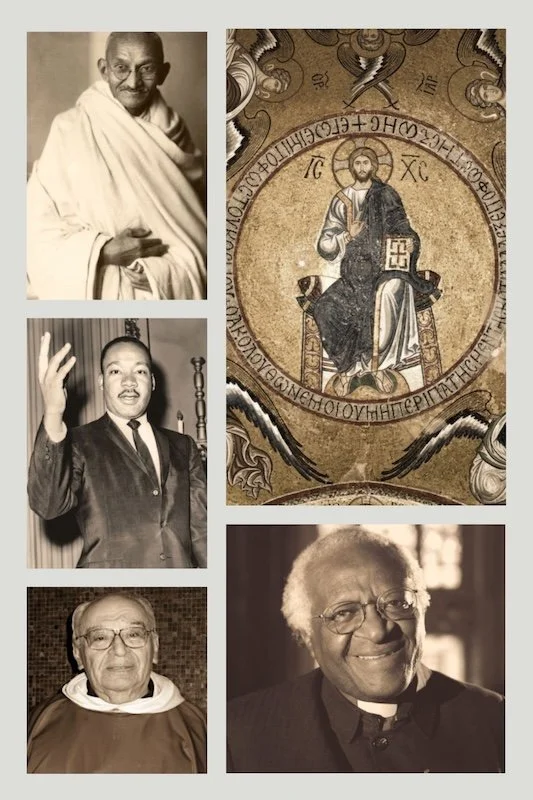
Within the spiritual community, there have been leaders — real leaders, on a global scale — who have recognized this.
Ghandi: “I shall not submit to injustice from anyone. I shall conquer untruth by truth. And in resisting untruth, I shall put up with all suffering.”
Martin Luther King, Jr.: “Injustice anywhere is a threat to justice everywhere. We are caught in an inescapable network of mutuality, tied in a single garment of destiny. Whatever affects one directly, affects all indirectly.”
Desmond Tutu: “A person with ubuntu is open and available to others, affirming of others… is diminished when others are humiliated or diminished, when others are tortured or oppressed, or treated as if they were less than who they are.” And also: “If you are neutral in situations of injustice, you have chosen the side of the oppressor.”
Gustavo Gutiérrez: “A poorly understood spiritualization has often made us forget the human consequences of the eschatological promises and the power to transform unjust social structures which they imply.”
Jesus: “For I was hungry and you gave me food, I was thirsty and you gave me drink, I was a stranger and you welcomed me, I was naked and you clothed me, I was sick and you visited me, I was in prison and you came to me. Truly I say to you, as you did it to one of the least of these my brothers, you did it to me. Truly I say to you, as you did not do it to one of the least of these, you did not do it to me.” (Matthew 25:31–45)
Confronting injustice and oppression isn’t in contradiction with true spirituality. It’s the essence of it.
What Allyship Actually Looks Like
Maybe you are someone who genuinely does see the beauty in all people, regardless of neurotype, race, gender, or any other aspect of identity. That is a beautiful thing to carry.
But on a systemic level, that personal capacity to see beauty does nothing — until it is paired with a willingness to see harm. To hear how people have been hurt. To understand the systems — at the micro (family, relationship), mezzo (community, organization), and macro (societal, global) levels — that have done the hurting. And to use whatever privilege and platform you have to push back against those systems.
Real allyship is not saying “we’re all the same.” It is saying “I see that your experience has been different from mine, and I want to understand it, and grow with you through that sharing — and I want to use whatever privilege and power I have to help change what needs changing.”
That’s how real change happens. Not by erasing the differences, but by seeing them clearly enough to dismantle what’s built on top of them. Including those unscrupulous, oppressive, exploitive people and systems who do, indeed, use separation and difference to drive wedges between groups in order to obtain and maintain power and wealth.
The neurodivergent people I work with — and the one I see in the mirror — have been put down, misdiagnosed, bullied, mocked, institutionalized, and pathologized for being different. For most of human history, our differences were treated as defects. We’ve been told we were broken when we were, in fact, just wired differently in a world that hadn’t yet made room for us.
Writing about that. Naming it. Reclaiming it. Building understanding around it. That is not division.
That is how people who have been invisible become seen.
And I will not stop doing it.
A Brief Guide to the People Who Say This
Because not everyone who says “we’re all neurodivergent” means the same thing, and I think it’s worth naming the range.
Best case: an actual ally — a parent, a teacher, a caregiver — trying awkwardly to cross a gap they don’t quite know how to bridge. Saying “we’re all neurodivergent” as a fumbled attempt at solidarity, like wearing a “We’re all immigrants” shirt to a rally. Well-intentioned, probably opening a door to conversation. Start there. Most people in this category will be open to learning more if you invite them to.
Common case: dismissive and uninformed but not hostile. The person who tells you about their “ADHD moments” (forgetting their keys, running 10 minutes late) when you disclose that you’re an ADHDer. Or says “isn’t everyone a little bit autistic?” with genuine puzzlement. Not trying to harm. Just genuinely confused about what neurodivergence is. This is an education moment if you have the energy for it.
Worst case: a neurodivergent person tries to describe something about their experience — often as an appeal for understanding, often after already being hurt — and gets back “everyone is neurodivergent these days” with an eye roll. This is traumatic invalidation. It is a form of aggression. And it is a form of ableism — the same category of oppression as racism and sexism, directed at those who are differently abled.
I know which one hurt the most when I was on the receiving end of it.
What I’m Asking
I don’t ever again want to hear someone say “we’re all neurodivergent” in that dismissive, erasing way when I try to speak or write or advocate about neurodiversity, including my own experience as well as that of the clients and community I work with.
You haven’t made yourself superior or compassionate in saying that. You’ve made yourself part of the problem.
But you can also choose to become part of the solution.
The work isn’t transcending difference. The work is finally, actually seeing it — and choosing to stand on the right side of it.
Help shape the book
I’m writing a book for late-identified neurodivergent adults, and I want it grounded in real lived experience — not just mine. If you have a few minutes, I’d love your voice in it.
👉 Contribute to the community survey: https://tally.so/r/7RE8ga
Works Cited
Dalsgaard, Søren, et al. “Mortality in Children, Adolescents, and Adults with Attention Deficit Hyperactivity Disorder: A Nationwide Cohort Study.” The Lancet,vol. 385, no. 9983, 2015, pp. 2190–2196. https://doi.org/10.1016/S0140-6736(14)61684-6.
[Note: The overall mortality rate ratio for all ages is 2.07. The “more than four times” figure (MRR 4.25) applies specifically to adults diagnosed with ADHD at age 18 or older.]
Hirvikoski, Tatja, et al. “Premature Mortality in Autism Spectrum Disorder.” The British Journal of Psychiatry, vol. 208, no. 3, 2016, pp. 232–238. https://doi.org/10.1192/bjp.bp.114.160192.
[Note: This study found markedly elevated mortality across multiple medical conditions. The widely cited “16 years shorter life expectancy” figure is a documented misinterpretation of its findings; see O’Nions et al. below for the more precise life expectancy estimate.]
O’Nions, Elizabeth, et al. “Estimating Life Expectancy and Years of Life Lost for Autistic People in the UK: A Matched Cohort Study.” The Lancet Regional Health — Europe, vol. 36, 2023, article 100776. https://doi.org/10.1016/j.lanepe.2023.100776.
[Note: Life expectancy reduction ~6 years for autistic men and women without intellectual disability; up to ~14.6 years for autistic women with co-occurring intellectual disability. Authors flag that the diagnosed population likely over-represents those with greater support needs.]
Patil, Mahie, Nofel Iftikhar, and Latha Ganti. “Neuroimaging Insights into Autism Spectrum Disorder: Structural and Functional Brain.” Health Psychology Research, vol. 12, no. 1, 2024, p. 1. https://doi.org/10.52965/001c.123439.
[Note: Open-access peer-reviewed review; synthesizes findings including a multisite study of 1,500+ participants for the amygdala volume claim. Lower-tier journal, but the underlying findings are well-replicated across the literature.]
Shaw, Philip, et al. “Attention-Deficit/Hyperactivity Disorder Is Characterized by a Delay in Cortical Maturation.” Proceedings of the National Academy of Sciences, vol. 104, no. 49, 2007, pp. 19649–19654. https://doi.org/10.1073/pnas.0707741104.
[Note: NIMH landmark study, 223 ADHD children and 223 matched controls. Cortical thickness peaked at ~age 10 in ADHD vs. ~age 7 in neurotypical peers; delay most pronounced in lateral prefrontal cortex. The 2–3 year range is confirmed in this study and its 2012 follow-up.]
Tick, Beate, et al. “Heritability of Autism Spectrum Disorders: A Meta-Analysis of Twin Studies.” Journal of Child Psychology and Psychiatry, vol. 57, no. 5, 2016, pp. 585–595. https://doi.org/10.1111/jcpp.12499.
[Note: Meta-analysis of 7 qualifying twin studies (n = 6,413 twin pairs). MZ correlation .98; heritability 64–91% depending on assumed prevalence rate. Widely replicated.]
Welwood, John. “Principles of Inner Work: Psychological and Spiritual.” The Journal of Transpersonal Psychology, vol. 16, no. 1, 1984, p. 63.
— -. Toward a Psychology of Awakening. Shambhala, 2000.
